"That is THE question..."
Together or each in your own boat? A question worth thinking through before you arrive at the base.
As river professionals who have witnessed all kinds of scenes on the water, we feel duty-bound to share a few home truths.
For a couple who have promised to paddle together in the same craft, the tandem kayak seems like the obvious answer. Sharing this experience on a river as a couple is completely legitimate — let’s all remember “Together, to love each other faithfully, in joy and in hardship, and to support one another, throughout our lives.” But let’s first lay down a few ground rules that may influence your choice.
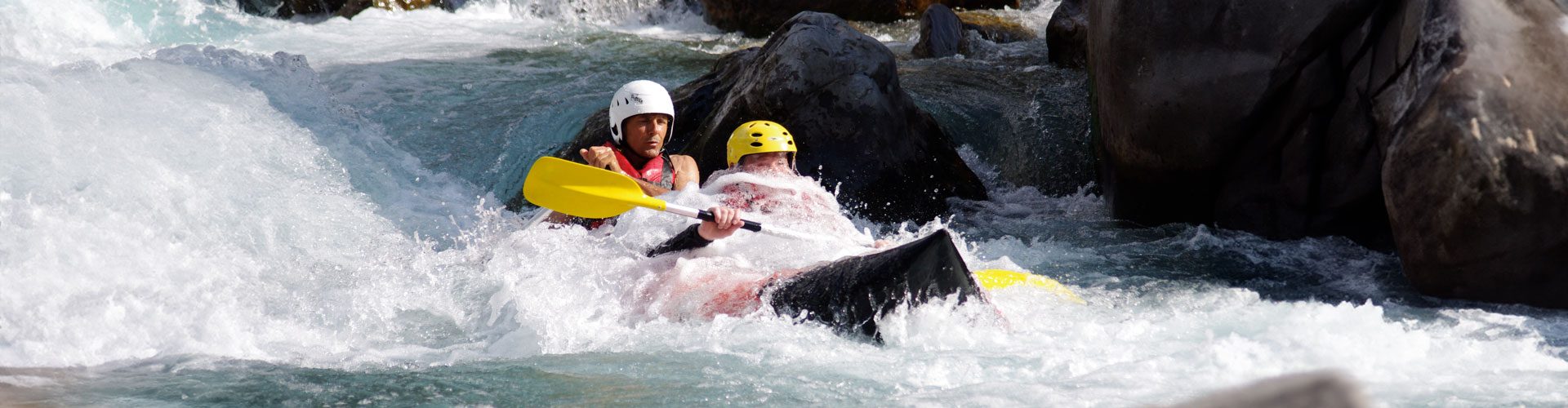
Sometimes you have to face certain realities. The tandem kayak is paddled as a pair: one weight at the front, one at the back. These two masses — positioned close to the bow for one paddler and the stern for the other — create what kayakers call a “tracking” effect: the boat holds its line but becomes harder to pivot and steer. This is known as the “beam” effect.
In contrast to the solo kayak, where the single weight sits at the centre of the boat. That pivot point makes for easier turning and better glide. This initial drawback of the tandem kayak is amplified when both paddlers are a similar build.
Who leads and who follows?
Front or back?
Each person’s role in a two-person craft must be established clearly from the start. The “captain” at the back takes charge of steering: they read the river, spot what’s coming downstream and anticipate the line. They steer with the right paddle stroke to point the bow in the correct direction. At times, on major corrections, they call instructions to their partner at the front to optimise the trajectory.
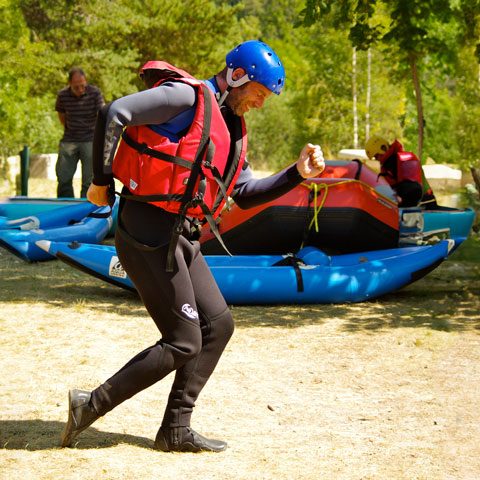
At the front, the “engine” generates speed and drives the directional strokes set by the captain. The faster the front paddler goes, the more effective the angle set by the captain’s paddle becomes. The front partner also listens out for instructions called from behind.
This is a role-play that each person must commit to. Stick to it, act instinctively, each from their own position — it rarely works any other way. No, the tandem kayak is not a democracy. The best way to stay forgiving of your partner: swap places. That way, each person understands the sometimes complex role of their own seat and their partner’s, and together you find the best compromise — a balance, clear and generous communication, right up to perfect harmony.
At Oueds & Rios, drawing on our long and happy experience, we always share this information with couples when handing out the craft.
There’s always a solution
Our goal is for everyone to have a great time on the water in the best possible conditions. When faced with a highly motivated couple, we let them choose their own craft freely. In our logistics, we always arrange for an alternative to be available on the water if the “couple’s descent” turns electric rather than harmonious. Of course, the tandem kayak is perfectly suited when one partner isn’t yet comfortable managing a solo craft — and so places enormous trust in the other!
The guide can take the more impatient of the two into the tandem kayak. The other will take the guide’s solo kayak, relieving the tension and allowing them to focus more calmly on their descent. We do everything we can to make sure the lovebirds leave our rafting base in the same vehicle, with the unforgettable memory of a beautiful adventure on the Ubaye.
A story to make you smile
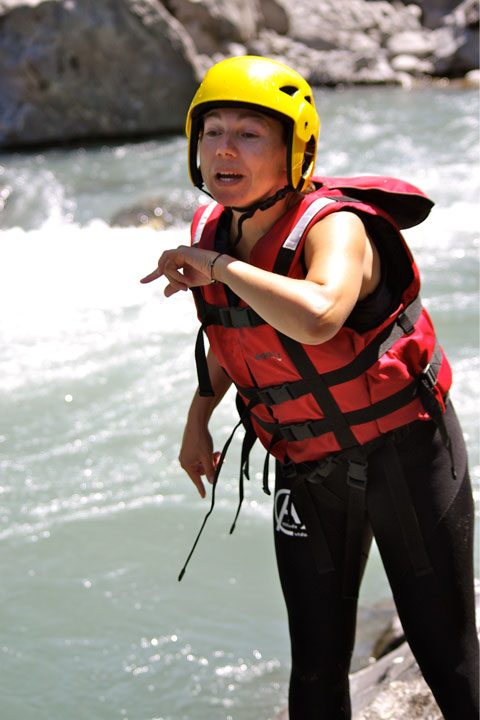
A story told — and lived — in the Gorges de l’Ardèche, by guide Philippe Gaboriaud — “Gabo” — who had volunteered with the big canoe rental operators on the Vallon-Pont-d’Arc to act as tail-end guide during the busy rental days. The operators’ priority: get as many boats arriving within the same time slot as possible, to optimise the return shuttle trailer. In this semi-industrial world, there’s no room for laughs.
This guide would push the “stragglers” to keep to the timing on the river. Until one day… he found a woman alone at the water’s edge. One can imagine the descent had started well enough from the Pont-d’Arc, in a lovely mood:
“Darling, I’ve put your sunscreen right next to you.”
“Thanks sweetheart, your drink is right there too.”
Then, as the journey went on, when things stopped going smoothly — or rather started going too round in circles, since in a tandem it’s always the other one’s fault — the tone shifted. A spell of icy silence, an awkward pause… then a flash. That day, the argument had been so explosive that he had simply left his beloved at the riverside — or perhaps she had chosen to jump ship. The story doesn’t say.
“Teach me to love you, my love,
I want to rest forever in your arms,
Show me your desire and your greatness,
Take me somewhere wonderful,
If you love me and adore me,
Your name will live in my heart in letters of gold,
If my heart, if my heart is your heart,
Then yours must be mine too…
But for heaven’s sake, what an idea — a tandem kayak trip!!”
A lesson in life, this two-person kayak. Fortunately, harmonious descents as a couple are the norm — and the guides play a big part in that. Bring a zen attitude, a dose of tolerance, a pinch of trust… and above all, communication. So test yourselves in a “hostile” environment, and maybe afterwards you’ll dare to set off to the ends of the earth — by sailboat, by bike, by hitchhike — with your better half.
Also read: Solo or duo kayak: what’s the difference?
Book a kayak session Learn more about kayaking 🎁 Give a kayak session
![Solo or duo kayaking? [For couples]](/web/image/blog.post/25/author_avatar/Solo%20or%20duo%20kayaking%3F%20%5BFor%20couples%5D?unique=3c559d1)